Photography as an Art Form

From the moment photography was invented in 1839 to the middle of the last century, a heated debate has raged on whether it is a form of art, or simply a way of using an optical-mechanical contraption to document reality. Now we know that photography is indeed an art form, moreover, its unique features make it distinctly different from its closest relative: painting.
Photography as an Art Form — What makes Photography Art?
To answer this question, we need to go all the way back to the definition of art itself. Even though Merriam-Webster defines art in a clear and concise fashion as “something that is created with imagination and skill and that is beautiful or that expresses important ideas or feelings”, things are not that simple.
Leo Tolstoy wrote a whole book called “What Is Art”, yet do not expect to get all the answers there. However, going back to the classic definition, one can see that photography possesses everything to be an ideal medium for creative expression. Yet, there are ways to use photography for purely utilitarian purposes, and one can argue that is its primary earmarking.
Photography is a language, which uses visual elements in lieu of words, therefore, just as any language, it can be used for artistic purposes. Just like English, which is perfectly appropriate for writing a rental contract with a landlord and equally good for creating most beautiful poetry, photography serves its dual purpose without any contradiction.
What distinguishes a true artist is his or her having something important to say and striving to deliver this message to the world. It is the human ability to interpret any piece of information (including visual) in a variety of ways that gives an artist the freedom from being literal.
Good photographers do it exceptionally well. Their work is always open for interpretation, it asks questions rather then gives answers.
As any visual art form, photography exploits vulnerabilities of the human visual perception and can make us experience emotions that move us and compel us to do things that we otherwise would not even think of. It is Jessica Lange’s series of photos showing inhumane conditions on American factories that made the lawmakers enact Child Labor Law, it is Carleton Watkins’ landscapes were the reason for Abraham Lincoln’s signing the first federal government act to preserve a part of nature for the common good now known as the Yosemite National Park.
Why can photography influence people so profoundly?
Unlike painting, photography requires a real physical object to be there to take a picture of it. This very fact is the reason why we perceive any photo as something more real than any other type of visual representation of reality. This is something that is truly unique to photography, and it took some time for artists who chose photography as their means of creative expression to understand.
Pictorialists who were the first group of photographers positioning themselves as fine artists, for the most part, were trained painters. Those who were not, still were greatly influenced by traditions and techniques of painting. Hence they did not understand photography’s unique property and merely saw their work as photographic paintings.
Despite profound visual and emotional appeal of pictorial photography and numerous techniques that pictorialists developed to distance themselves from “simple craftsmen”, their art was not groundbreaking. The pictorial movement emerged during the early years of photography and became especially active in the last quarter of the 19th Century, when photographers were still confined to working with stationary objects and people. Limitations of the photographic equipment was in part responsible for pictorialists’ sparse understanding of what photography really is capable of.
Thanks to Oscar Barnak who built the first successful 35mm camera and advances in film technology, photography broke free.
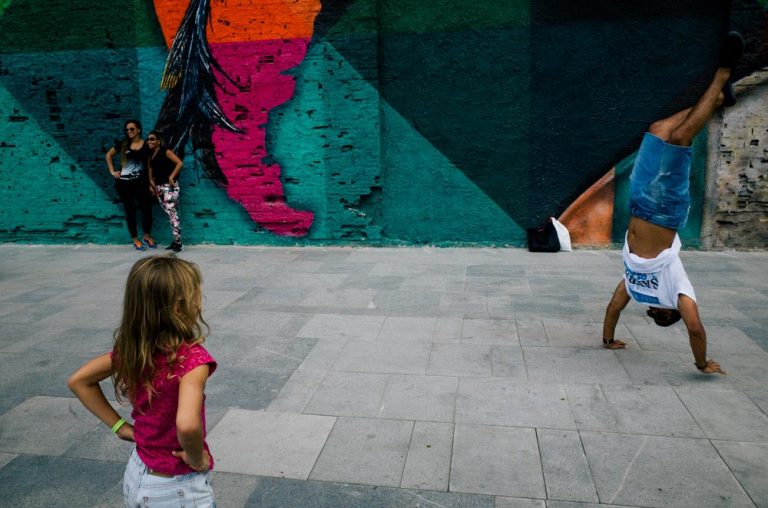
Henri Cartier-Bresson, armed with a small and unobtrusive Leica essentially invented and perfected the genre of candid photography and its applied form, photojournalism. Cartier-Bresson coined a famous term, the “decisive moment”, which became a trademark of his style and a recipe for his numerous followers and imitators. Doing strictly “candid photography”, Cartier-Bresson figured out how to successfully capture the unexpected by being spontaneous. The spontaneity enriched photography immensely by making it even more believable.
Browsing through hundreds of the most famous photographs of the past you can easily notice that every one of these pictures is more or less spontaneous. It is the spontaneity that helps a photographer create an illusion of ease and effortlessness. It is the spontaneity that makes photography so similar to Jazz, as opposed to the strictness of painting, which makes it so similar to classical music.
On one hand, photography does represent reality and cannot exist without it. On the other hand, it can distort and misrepresent reality with different degrees of subtlety. This is the reason why surrealists embraced photography so eagerly.
Using both purely technical means (like double exposures, montage, forced perspective, cross-processing, solarization, etc.) and semantics (multiple meanings, allusions, context manipulation), they managed to create pictures seemingly highly personalized in a sense that each spectator tends to interpret these photos based disproportionately on his or her subjective perception and identify with the images on a very personal level. It’s no wonder that fashion and advertising professionals adopted surreal photography so quickly and effectively.
Related: What Photography Means to Me by Dana Crandell
Artistic Differences Between Photography and Painting
One of the notable differences between painting and photography is the fact that photographic technique is transparent. What it means is that by virtue of being rather complex and difficult to master, technical skills of a painter are considered an integral part of a painter’s artistic talent.
Photography is not like that at all.
Current advancements in photographic technology made it possible for anyone to take a technically sound photo and even accidentally create a masterpiece. Therefore, when a photo is technically perfectly executed, it is perceived as something not worth talking about, and only when something is wrong, the viewer will note a problem with focusing or exposure.
Even good understanding of properties of light does not turn one into an artist, as simply being in a right place in a right time can result in a very aesthetically pleasing photo, even though it was taken without any awareness of the lighting conditions.
It is the transparency of photographic technique that makes photographers look for things that define photography as an art form. It is the very reason why artists who use photography is their means of creative expression see the world differently, give us a fresh and unusual view on reality and find ways to play with our emotions making us feel and even see things that are not even there.